Case study

Our Work / Research & Evidence
Our work page shows what PTR has built and who has used it. This page collects the peer-reviewed studies, program evaluations and reported outcomes behind that work, each with the authors, publication and method named.
Client evaluations and published research behind our work. Download the PDFs to share with your team, or request the full Mayo Clinic case study.
Case study
Case study
Research paper
Case study, on request

The case studies describe PTR's delivery and the clients' experience. Each research summary here identifies the authors, publication, method, sample and reported results.
The Google project was co-designed by PTR, led by co-founder Leonie Sanderson, with Google's DEI volunteers; People Tech Revolution built the Mayo Clinic project with Equal Reality, a subsidiary of People Tech Revolution.
Two peer-reviewed studies, examined in full on their own pages.

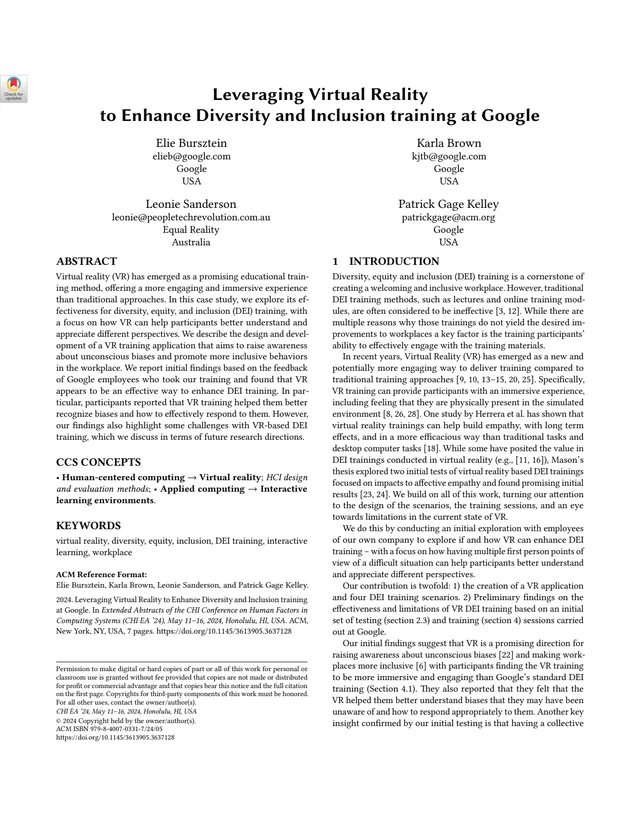
A case-study paper co-authored by Google researchers and Leonie Sanderson of Equal Reality, published as an extended abstract at the CHI 2024 conference.
It describes four VR diversity, equity and inclusion training scenarios and reports preliminary, self-reported feedback from a small group of Google employees who trialled the training in September 2023.

Two peer-reviewed papers by Mayo Clinic researchers examine a VR DEI and empathy training program People Tech Revolution built, offered to 1,149 eligible Mayo Clinic nurse and social worker leaders.
One paper describes the rollout; a second, using a controlled trial design, measures the effect on empathy and upstander-behaviour intentions, including a 6 to 8 month follow-up.
Read the summary → · Full citations
Mater Education's pilot evaluation appears below under Mater's name; every other reported outcome sits on its own page.

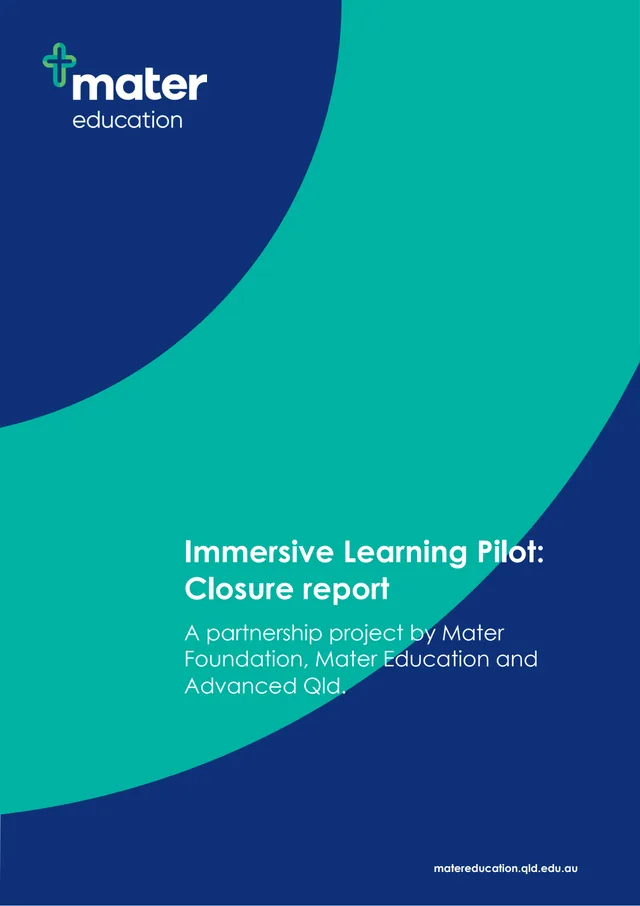
Mater Education's own program evaluation of its VR training for psychologically safe conversations, "Speaking with Good Judgement: Through the Looking Glass," reported that 93% of participating staff enjoyed the experience and 90% reported an increase in their concentration.
Read the summary → · Every other reported outcome: Central Coast Council and Cook It!
The Google and Mayo Clinic papers report participant ratings and describe facilitated debriefs; the Mayo Clinic trial also compared groups and measured results again 6 to 8 months later.
peer-reviewed papers examine the Mayo Clinic trial's control group and its 6 to 8 month follow-up
independently peer-reviewed papers in total sit behind this page, cited in full on the papers page
The papers, the featured findings and the program outcomes each have a page, with the setting the work was measured in.


"We could see how powerful VR is at giving people 'a-ha moments' and wanted to create training that has an impact on people's behaviours."
 Leonie Sanderson
Co-founder, People Tech Revolution. Startup Spotlight, Aerospace Xelerated, 2023
Each one put staff inside a moment from their own kind of workplace, asked them to choose a response, then talked it through.

Trainees lived through workplace incidents drawn from what Google employees had shared, chose whether to call the behaviour out, call it in or let it pass, then discussed that choice with a facilitator.
Anonymous surveys after testing and after the first cohort asked whether the scenes felt real and whether the format built empathy. What they reported

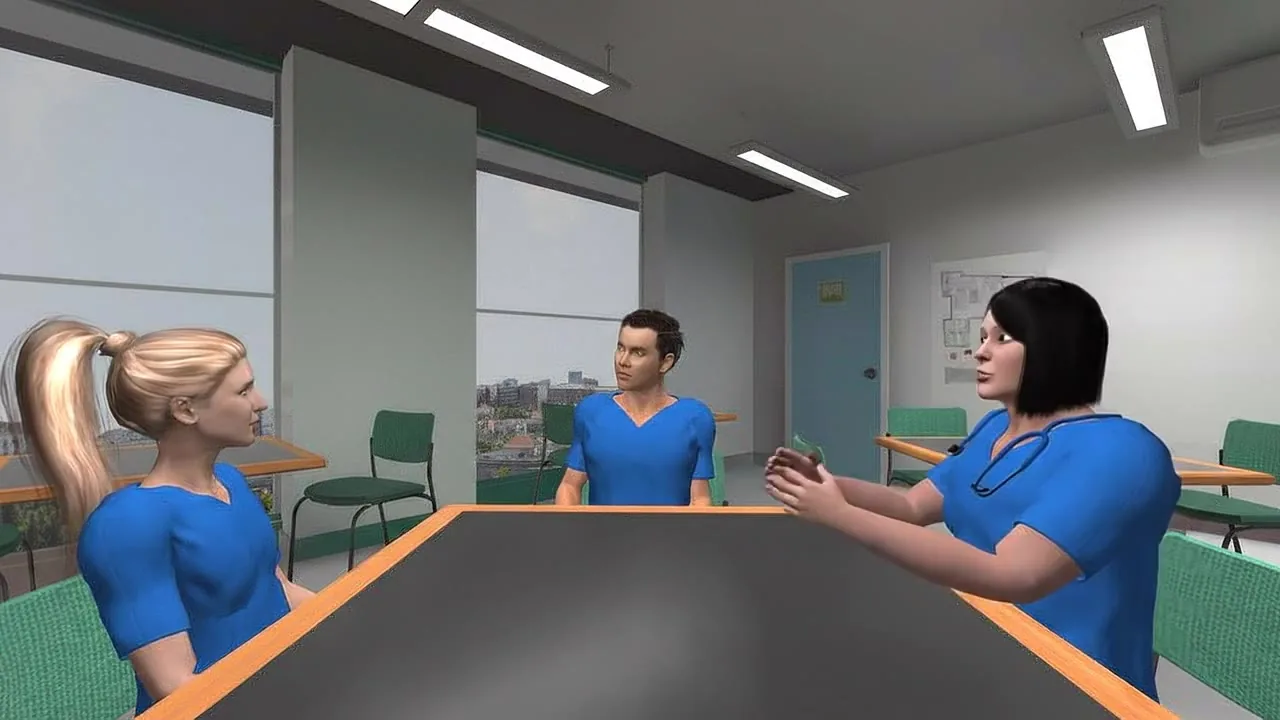
Staff stood in Mater rooms recreated in VR, watched colleagues handle a hard feedback conversation, then chose what to say next and saw the consequences play out.
Mater Education’s own evaluation then asked staff about their concentration, how engaging the scenes were and whether they wanted more VR learning. What Mater found

Nurse and social worker leaders first experienced bias as a Black nurse, then practised responding in their own voice, in a breakroom and a patient room co-designed with staff who had lived it.
Researchers compared them with a control group and measured again 6 to 8 months later. What changed
Want the evidence behind a specific page, or to talk about running your own evaluation?
Our Work / Research & Evidence
Our work page shows what PTR has built and who has used it. This page collects the peer-reviewed studies, program evaluations and reported outcomes behind that work, each with the authors, publication and method named.
The case studies describe PTR's delivery and the clients' experience. Each research summary here identifies the authors, publication, method, sample and reported results.
The Google project was co-designed by PTR, led by co-founder Leonie Sanderson, with Google's DEI volunteers; People Tech Revolution built the Mayo Clinic project with Equal Reality, a subsidiary of People Tech Revolution.
Two peer-reviewed studies, examined in full on their own pages.
A case-study paper co-authored by Google researchers and Leonie Sanderson of Equal Reality, published as an extended abstract at the CHI 2024 conference.
It describes four VR diversity, equity and inclusion training scenarios and reports preliminary, self-reported feedback from a small group of Google employees who trialled the training in September 2023.
Two peer-reviewed papers by Mayo Clinic researchers examine a VR DEI and empathy training program People Tech Revolution built, offered to 1,149 eligible Mayo Clinic nurse and social worker leaders.
One paper describes the rollout; a second, using a controlled trial design, measures the effect on empathy and upstander-behaviour intentions, including a 6 to 8 month follow-up.
Read the summary → · Full citations
Mater Education's pilot evaluation appears below under Mater's name; every other reported outcome sits on its own page.
Mater Education's own program evaluation of its VR training for psychologically safe conversations, "Speaking with Good Judgement: Through the Looking Glass," reported that 93% of participating staff enjoyed the experience and 90% reported an increase in their concentration.
Read the summary → · Every other reported outcome: Central Coast Council and Cook It!
The Google and Mayo Clinic papers report participant ratings and describe facilitated debriefs; the Mayo Clinic trial also compared groups and measured results again 6 to 8 months later.
peer-reviewed papers examine the Mayo Clinic trial's control group and its 6 to 8 month follow-up
independently peer-reviewed papers in total sit behind this page, cited in full on the papers page
The papers, the featured findings and the program outcomes each have a page, with the setting the work was measured in.
"We could see how powerful VR is at giving people 'a-ha moments' and wanted to create training that has an impact on people's behaviours."
Leonie Sanderson
Co-founder, People Tech Revolution. Startup Spotlight, Aerospace Xelerated, 2023
Each one put staff inside a moment from their own kind of workplace, asked them to choose a response, then talked it through.
Trainees lived through workplace incidents drawn from what Google employees had shared, chose whether to call the behaviour out, call it in or let it pass, then discussed that choice with a facilitator.
Anonymous surveys after testing and after the first cohort asked whether the scenes felt real and whether the format built empathy. What they reported
Staff stood in Mater rooms recreated in VR, watched colleagues handle a hard feedback conversation, then chose what to say next and saw the consequences play out.
Mater Education’s own evaluation then asked staff about their concentration, how engaging the scenes were and whether they wanted more VR learning. What Mater found
Nurse and social worker leaders first experienced bias as a Black nurse, then practised responding in their own voice, in a breakroom and a patient room co-designed with staff who had lived it.
Researchers compared them with a control group and measured again 6 to 8 months later. What changed
Want the evidence behind a specific page, or to talk about running your own evaluation?


